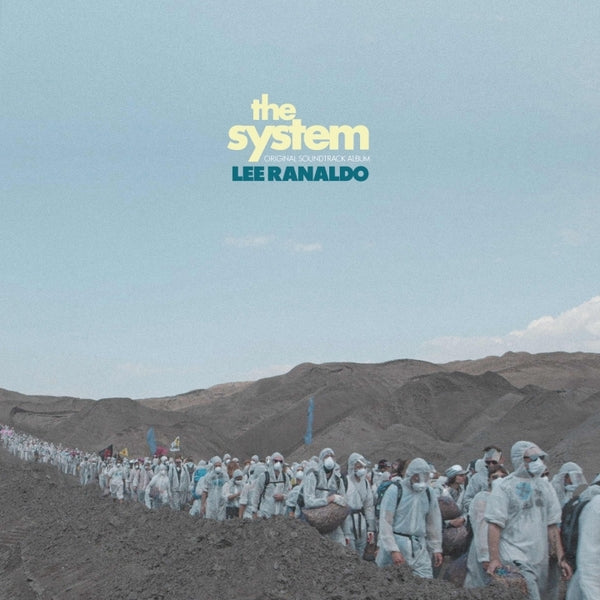
RANALDO, LEE - The System
Couldn't load pickup availability
"A quick scan of the world's favorite crowdsourced discography reveals that Sonic Youth co-founder Lee Ranaldo was not a total stranger to crackling electric experimentation in the years following his songwriting turns of the 20-teens. Yet The System , ingeniously culled and sequenced from Ranaldo's soundtrack work for Dutch filmmaker Joris Postema 's 'eco-doc' of the same name nonetheless feels like a reawakening. Quietly released in a vastly different form by Doxy Music/Riva Media Records in 2025, this LP reimagines and reconfigures the initial release, including unreleased material (written and recorded for the film) to lend it new stature as both a return to drone-improv form and a reunion with introspective Downtown angst. As it turns out, the gorgeous scope of Lee Ranaldo's guitar palette is a perfect manifestation of the hope and despair that animates the film. But like other high-water marks in the guitar-centric soundtrack canon -- the high plains raga of Bruce Langhorne 's 'Hired Hand,' Neil Young 's sparse and ghostly solo transmissions on 'Dead 'Man,' or the monolithic mantras of Popol Vuh 's 'Nosferatu' -- its devotion to spectral gestures and meditative song forms launches it firmly outside of the OST orbit into a universe fully its own. As the LP unwinds, and collaborators like Jim Jarmusch , cellist Leila Boudreil , Yeah Yeah Yeahs snare shaman Brian Chase and guitarist Yonatan Gat take their places, new vistas unfurl -- the ritualistic thrum of 'Berlin Blockade,' the haunted overtone palaces of 'Bergelmir,' the cavernous acoustic strumming of 'Instruments of Violence.' It all winds up with the high lonesome standard 'Cool Water,' each unhurried note trailing off into long-tail reverb, layers of shifting vocal harmonies pulling everything skyward -- a hopeful note in an album where existential dread never lurks too deeply below the surface. In the end, The System functions both as a film score and a hallucinatory (mostly) instrumental guitar record, revealing a sensibility not too often spotted in the 21st century -- a liminal space where the song, the jam, the meditation merges into a blurred whole."