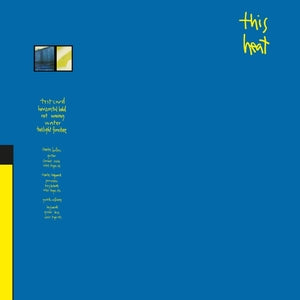
THIS HEAT - This Heat
Couldn't load pickup availability
""There's an irony inherent in the term 'postpunk.' Many of the groups that define the genre (think Pere Ubu or Cabaret Voltaire ) existed for several years before punk. But these outfits had little hope of finding an audience until punk stirred up an appetite for the extreme, while also spawning a new breed of independent labels that could support challenging music. This Heat are a prime example. Formed in early 1976 by drummer Charles Hayward , guitarist Charles Bullen and 'non-musician' Gareth Williams , the group were initially unaware of what was brewing elsewhere in London, yet they were driven by similar impulses: to make noise expressive of the era's turbulence. Instead of punk's crude reduction of rock 'n' roll, This Heat took their bearings from expansive inspirations: free jazz, Captain Beefheart , musique concrète, and reggae's disorienting dub techniques. Vital to their evolution was Cold Storage, a disused meat fridge in Brixton where the band rehearsed. Produced by This Heat with David Cunningham and Anthony Moore , their 1979 debut was collaged out of cassette tapes and recordings made during ultra-cheap graveyard shifts at The Workhouse. The jump-cuts in sound quality were deliberately designed to make the album more unsettled and jarring. The first two principles of This Heat's mission statement -- 'All possible processes. All channels open.' -- could have been co-signed by many pre-punk experimentalists. It's the third part -- '24 hour alert.' -- that makes This Heat archetypally post-punk, crystallizing the 'totally-wired' mood of paranoid vigilance they shared with peers like Scritti Politti and The Pop Group . Soft power -- the mind-control of television and advertising -- was an obsession; several tracks take their titles from the gogglebox ('Testcard,' 'Horizontal Hold'). But hard power -- in particular, geopolitical dominance -- is also addressed in tracks like 'The Fall of Saigon.' Perhaps the most startling piece here is '24 Track Loop.' Breakbeat-like drums are processed using the Eventide Harmonizer, a machine famously used on Bowie's Low. The song's creaky textures and pitch-shifted beats anticipate '90s jungle, but the entire album is a controlled explosion of ideas. Nearly fifty years on, This Heat's debut is something the world has still not completely caught up with." -- Simon Reynolds"